

by Rhiannon White, Managing Editor, Milling and Grain
Challenges, solutions and future aims for feed safety and sustainability
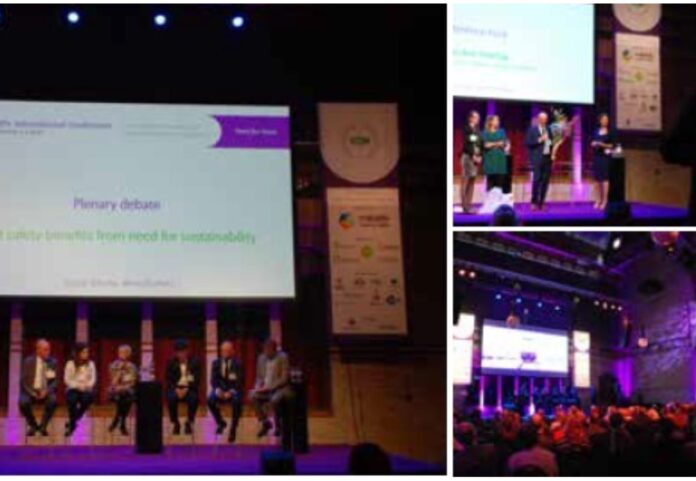
In November 2017, global leader for feed safety certification, GMP+ International, invited around 100 delegates from around the world to a special conference that celebrated its 25th anniversary. It was fittingly held at The Beurs van Berlage in the center of Amsterdam, a historic venue of 19th to 20th century corn and grain exchange. Over the two days, rather than grain itself, over 20 experts exchanged their insights about challenges, solutions and future aims for feed safety and sustainability, through a mixture of short presentations and lively debates.
Alongside the conference, delegates were treated to a walk-in exhibition of artist and photographer, Laurent Bellec"s imaginative and unique photography that he has spent the last seven years producing. His photographs capture feed mills in all their glory from around the globe and his publications offer a thought-provoking vision of the future relationship between feed milling and our everyday lives.
In recognition of the interdependent relationship between feed and food safety and security, this report focuses on highlights from six of the presentations given. They discuss the imminent effects of climate change, the promise of big data, the increasing global demand for protein, the need for novel feed and the potential approaches towards achieving sustainability within the feed industry, all without compromising feed safety.
The GMP+ International journey
All the way back in 1992, several incidents involving contamination in feed materials in the Netherlands provoked the Dutch feed industry into developing a code for best practices, otherwise known as "Good Manufacturing Practices" or GMP. In 2000, the Hazard Analysis and Critical Control Points was included in the scheme, which made the system more preventive and proactive. Realising however, that a chain is only as strong as its weakest link, it was also decided that a GMP+ FSA certificate was to be required from suppliers, which later expanded to include transporters, intermediaries and storage companies.
Introducing the Early Warning System and Tracking & Tracing has further helped companies to react quickly in the case of incidents. Also, since GMP+ certificated businesses can only trade with companies that are certificated as well, corporations of other countries started joining the scheme. Having this independent international standard for safe feed was a crucial step because often national legislations can vary from country to country.
In response to increasing importance of sustainability, in 2014 the Feed Responsibility Assurance was launched as an add-on certificate to GMP+ FSA, as proof of a sustainable and responsible work method. In 2016, an impressive 350 companies received this certificate.
By 2017, the Feed Fraud Program was launched with the aim of encouraging companies to be alert to the potential risks throughout the production chain and to raise concerns in order to control them.
Today, across the globe over 17,000 companies in the feed chain are GMP+ Feed Safety Assurance certified although the company advocates that feed safety is a culture and mentality as much as it is a certificate on the wall.
We caught up with Johan den Hartog, Managing Director of GMP+ International to gain a personal insight into the journey, "When I look for collaboration in a non-competitive way I always look to see if there is a common interest. A lot of companies realise that feed safety is not a competitive issue because when a big company has control over feed safety and its competitor, maybe a smaller one, does not have it, and something happens, the big one also faces the problem of losing trust from the market. So it is a common interest."
Acknowledging that it"s important in general to make clear to the downstream market how the chain works, Mr Hartog explains, "Transparency is also about traceability; it should contribute to trust and also it"s important that a company is able to act quickly when something occurs. Not everything can be avoided but when something occurs you should be able to act very quickly so that the downstream chain will not be provided with contaminated feed.
"Whilst transparency should create trust, enabling companies to act as soon as possible, the system put in place by the company to control the risks is what is important rather than transparency itself."
Mr Hartog pointed to the fact that consumers expect and assume the safety of feed to be high quality so really it is a business-to-business communication so that businesses can guarantee customers that their product is safe.
"More than has been done so far, we need to communicate on the kind of systems in the production chain that we need to put in place. For us, it is also important to emphasise we cannot solve all problems. We facilitate companies dealing with the control of feed safety. It is the owners of each company who must realise it and we will help. For us, it"s important to see how we can facilitate companies to predict risk in feed safety in a non-competitive way."
He comments that the world is moving quickly and we have to renovate and challenge ourselves from time to time, which this conference offers.
"This conference is the start and opening of the door for a new phase of GMP+ International. Together with our new vision initiative, we will introduce a more ambitious goal of feed safety worldwide and to mark this, next year we will launch a new logo."
"Feed safety and food security, a close connection"
A view from: Angela Booth, Director of Feed Safety, AB Agri
"So in terms of where we are today, the subject is very much food security given the growing population, growing demand for livestock products and the pressure that is putting on food security."
Mrs Booth insisted that we"re going to have to be more efficient as a livestock industry, which means greater efficiency from fewer resources. She says this puts its own pressure on whether we do this through technology, but also creates the opportunity for the arrival of innovation and novel products.
So what four things cause a feed safety incident? "Firstly, ignorance and not being aware that a hazard exists. Secondly, incompetence, ineffective control systems and procedures, although quite often you find there are effective control systems and procedures it"s just they are not being followed. Thirdly, irresponsible acts – so the intentional breach of good practice for whatever reason be it sometimes time, cost or ease. Lastly, illegal acts and the breach of statutory regulations, whether knowingly or not."
She says another thing relevant to food security is that we have different expectations in terms of different supply chains around different parts of the world. Giving the example that there are still parts of the world today where human therapeutic drugs are being used as growth promoters, she states we need to make sure that our expectations are the same and that we operate to consistent standards worldwide.
"The supply chain is still a challenge. We have to put our emphasis on challenging proactivity, communication and keep on working on it, going back as far as we can to understand the risks and ensure they are controlled at every stage.
"One of the things that really worries me in terms of food security is that the demand for feed safety expertise is not going to decrease, it"s only going to increase and where do you find that feed safety expertise? Three elements worry me – the blend of skills that are required, the level of appropriate training that"s needed and lastly, how do we inspire a generation to get them involved in our industry?
"I"m quite passionate, particularly in the UK, about trying to develop some postgraduate training on feed safety where we can have professional people with an appropriate qualification."
"Climate change and its impact on sourcing and feed safety"
A view from: Dr Berhe Tekola, Director of Animal Production & Health Division, FAO
"This 25th year anniversary is being celebrated not only by GMP+ International but also by the whole globe because the advantages are spread all around the world."
Dr Berhe reinforced other speakers" notions that without taking care of feed safety, we cannot talk about food safety. He says we need to be realistic.
"There are campaigns against the livestock sector but we need to keep on educating those to be realistic. Not everyone can be vegetarian even if they wish to. In 2050, the population of the globe will be about 9.6 billion – can we feed this population only by crops? It"s impossible. Can we command the productivity of crop by double and triple, we cannot – the land is limited and the resources are from time to time scarce."
The answer for Dr Berhe is livestock.
"In a limited area of a hector we can double, sometimes triple and quadruple when it comes to quantity. We must also address livelihood, climate and the environment. Business can be successful when we address livelihoods, when we address the whole community, developing the capacity of the small modern farming system to market-oriented kind of production. When you talk about animal welfare, it"s not only for the economic impact, and it"s not only for the social point of view, it benefits the environment because less stressed animals emit less methane gas."
He says the impact of climate change on crops and livestock varies from continent to continent, and its impact upon the demand is different as well.
"In many regions production is already being adversely affected by the raising of temperature, or temperature volatility and changes in the level and frequency of precipitation. In 2012, drought in the US created US$30 billion in agricultural losses, which had both a domestic and international impact.
"How is the feed safety issue being addressed in different parts of the world? I think we are quite successful in North America, in Europe and some of the Asian countries, but not in the majority part of Africa. We have to be transparent and rules will not work unless we implement them."
"Climate change and its impact on sourcing and feed safety"
A view from: Marcelo Martins, Managing Director EMEA, Cofco International
"With temperature increasing, we"re going to see an impact on all production areas and more risk of contamination especially with mycotoxins. Therefore, it is something we will need to work together on all throughout the chain. Our role here is to help producers protect their crops to know how to overcome the burdens that they have and at the same time to help the feed industry to understand what we are supplying, what kind of raw material we are consuming."
According to Martins, fast consumer growth is in countries that are not necessarily capable or equipped to handle it and they need help.
"For example in Bangladesh, there are 350 million people but conditions for storage are not at optimal level so even if we do all we can before to secure safety, if when we get there the raw material isn"t handled well, it means that we"re still going to have the risk of contamination.
"Going forward, there are many actions to take. We need to look for technologies that can prevent the spread of mycotoxins and we need to be more engaged with the key producers and help them to develop the practices that can improve the quality of foods they are producing."
"How data will challenge and secure feed safety"
A view from: Professor Dr Leo den Hartog, Director R & D and Quality Affairs, Nutreco NV
"Without feed safety, there is no food safety. Also there are a lot of facets surrounding this such as animal welfare, social aspects and the environment and they all have an impact."
Regarding new technology entering the market, Hartog drew the delegates" attention to the fact that we are now able to use one hair or one drop of blood to see if offspring will perform well, rather than having to look at the offspring like we would have done in the past. So now we can approach things much faster. Also with nutrition, he says we can impact the animals to produce more and in the coming 10 years, there will be more changes.
"We know that 60 percent of the cost on a farm is nutrition, so it means that precision and giving the animal what it needs is important.
"Nowadays it is stated that 25 percent of world food crops are contaminated with mycotoxins but I think personally it is even more. With a changing climate, this will be an issue for the future of feed safety. This is why we have developed the MycoMaster because you can go to the customer and right away show if there are mycotoxins in the raw materials.
"Four or five years ago we started up a lab and now are the first company who has in the pipeline and capabilities and competences in-house to analyse the microbiota in the animals to show the moment of action and to see what is going on. Then you get the big data spectrum, you have a lot of sequences of all the bacteria, which are there, and this allows us to understand how feed additives and feed affects the animal. With these databases, you can connect data and get more insights."
Hartog concluded that although we live in a very challenging world, emerging technologies have an enormous positive effect on feed and food safety and quality and animal health.
"How data will challenge and secure feed safety"
A view from: Dr Dries Berckmans, KU Leuven/CEO Soundtalks NV
"Precision Livestock Farming (PLF) is when you want to manage in a different way on a farm so you monitor different aspects – environment, production, reproduction, health, welfare and you do so in an automated, continuous way in real-time. For example, we are detecting automatically in real-time continuously and it"s a very good indicator for respiratory health problems in pigs and by giving early warnings, you can change management, you can do something about it and this is the answer that allows us to use less antibiotics for example."
"Similarly, we looked at what would happen if you don"t feed the broilers an unlimited amount and instead tried to control the amount of feed you give. What was demonstrated in the university in the commercial barn is that you end up with the same end-weight but you do it in a much more controlled way, it"s a lot more efficient, and you have a lot less mortality. But by growing more gradually, you give them the time to develop the bone structure and incur less problems overall."
He called upon the audience to remember that "animals are not machines so farmers, builders, farms, animals, they"re all individually different and we can clearly see our technologies also give different results and that should be taken into account."
He adds that no one actually really cares about data because what people want is information. But to get there we need reliable data.
"Therefore, in my opinion what you have to do is to transfer data into relevant information at the lowest level possible for example in the microphone, close to the camera but not in the cloud for example and then you combine a lot of relevant information later on for example we combine information about number of coughs per hour, we combine temperature, humidity, the weather information etc.
"For the first six months after we installed the technologies on farms, we were really shocked because nobody was using them and nobody cared about it. So we did one-day training sessions and the farmers became very interested in working with the system. So training is crucial if we want these technologies to be used.
"What was made clear for me is that there is a clear need for a service industry around using these technologies because they are too complicated to use without it. But then the big question comes, who owns the data? In my opinion, the farmer owns the data although I know there are a lot of different opinions on this. I think information needs to be shared and so do profits."
"Feed safety benefits from need for sustainability"
A view from: Ruud Tijssens, member of the Executive Committee, IFIF
"The starting point of sustainable development is safe feed and food. That is indeed a no-brainer, a clear connection. Feed safety is about managing potential risks throughout the supply chain.
"We have developed all kinds of management systems and ways to manage risks, and we have clear systems for how this information is travelling backward through the supply chain from the feed mill. We implement on top of that legislation, and protocols coming from companies like GMP+ International."
He says that our footprints, and our "feedprints" are starting to matter. "I"m working in a Dutch company and we have to deliver in the dairy chain from next year, actual figures of our CO2 feed print, so what we are delivering to the farmers, through the supply chain. That type of information is going to be requested.
"Another important subject in Europe is the development of PEF, the Product Environmental Footprint. It"s an obligatory legal framework of how you have to calculate your footprint and somewhere in time and it"s not clear how or when but this obligatory framework is going to be implemented."
Therefore, he suggests that you can clearly see that the origin of our raw materials is also going to matter and it matters how it is being processed. He predicts that sustainability is going to be about what we know about the origin of our raw materials. The question of course is are we ready for that?
"It is clear to me that in the long run, information and region of origin is going to matter and the feed safety industry is going to benefit from that.
"The whole process of raw materials should be based on risk assessment and I see exactly the same logic we have for feed safety because the criteria applies around the globe and are applicable for every raw material.
"Why should I discuss about crop rotation when they have already two or three crops a year? Why should I discuss about pesticides when they have no problem with pesticides? Why should I discuss about child labour when there are no problems with child labour?
"I am saying that the approach should be risk based otherwise you are never going to implement something tangible."
Conclusion
As the two-day conference drew to a close, delegates did not leave hungry – in body nor mind. Over a plentitude of delicacies at the close of day, the cornucopia of ideas that had been presented over the last two days were being digested and discussed by all creating an animated buzz around the hall. Faced with an unprecedented number of mouths to feed by 2050, the food industry is going to rely inherently upon the feed industry to ensure production chain safety and sustainability. It goes almost without saying that the GMP+ International journey is one of tremendous success for citizens on all continents and that the future is looking even healthier with the development of the industry in the hands of dedicated, driven and above all, collaborative experts.